Showing posts with label PTL. Show all posts

Saturday, May 1, 2021

27042021 - First Malaysian navy chief Thana recalls colour blind Malaysia

Credit to FMT

PETALING JAYA: When K Thanabalasingam was appointed chief of the Royal Malaysian Navy (RMN) in 1967, he scored a couple of firsts.


He was not only the youngest ever chief at 31, the British-trained naval officer was also the first Malaysian to helm the post.

Incidentally, his retirement, too, was a first as no head of service has ever left the armed forces at the age of 40.

What is interesting is that the Kuala Lumpur-born former Victoria Institution student was not the first name that was considered by Tunku Abdul Rahman, who was the prime minister when he decided to Malaysianise the navy’s top post which was then headed by an Australian.

The Tunku first asked senior army officer Brig Gen Mohd Sany Abdul Ghaffar to take the job.
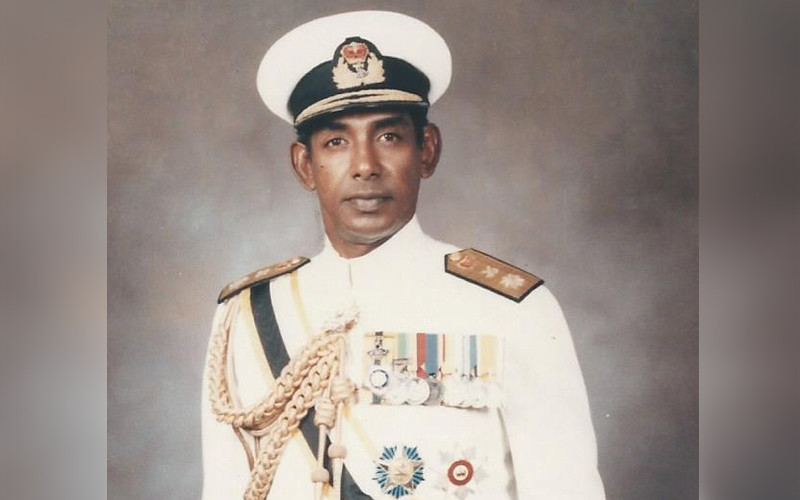
Thanabalasingam designed the Malaysian navy ensign, which is still in use, in 1968.

“But Sany represented the old Malaysia that I miss now. He was honest and admitted that he had very little knowledge in naval matters and told Tunku that a senior naval officer was the best person.

“It was then that my name apparently cropped up, presumably recommended by my superiors,” the 85-year-old Thana, as he is fondly known, told FMT in an interview in conjunction with Malaysian Navy Day today.

Recalling the day when the signal on his promotion arrived, Thana said he was annoyed with the signals officer of the brigade as he thought he was playing a practical joke on him. He had had no inkling of the promotion, as no one had told him anything.

At that time, he had been commanding the naval base in Tawau, Sabah, with the rank of lieutenant commander for only four months.

“I told (the officer) that his joke had gone too far and that I would deal with him when I see him in the officers’ mess.

“I got a shock when I saw a huge welcoming party at the mess. Then I began to realise it was true. I thought to myself, ‘Good heavens, how am I going to run the navy? All the immediate officers at the headquarters below me will be senior Britons and Australians’.

“No one in the right frame of mind would have imagined that a 31-year-old was going to head the navy. The funny thing is that I was never consulted nor asked if I could do the job,” he said.

One of his main tasks after taking over was to move the RMN headquarters in Singapore to Malaysia and that required much thought and planning.

Thanabalasingam welcoming Tunku Abdul Rahman during a visit to the Woodlands naval base in 1969.

The Tunku had told him he wanted the base to be in Port Klang but Thana had some reservations because of the location and availability of land.

“I met Tun Abdul Razak, who was then defence minister, to persuade him to consider Lumut. It was not congested and we had plenty of land. But he told me Tunku was adamant about having it in Port Klang.

“Then I happened to meet Tunku privately at a function and tried to convince him but he did not yield. It was at this time that May 13 occurred and the project had to be delayed. Emergency was declared and Tun Razak took over as the director of operations of the National Operations Council,” he said.

Soon after he became prime minister in 1970, Razak called up Thana and told him he could go ahead with the move to Lumut, assuring him that he had informed the then economic planning unit (EPU) head, Thong Yaw Hong, about it.

“He had told Thong that I would be contacting him. And the next morning, Thong called me up and asked what would be the budget.

“I must say Tun Razak’s brilliance helped when he put this project under the EPU, thereby taking it out of the tight defence budget.

“He also approved my request for assistance from the then West German government for the development of the naval base project.

“We chose the West German model because they had rebuilt their bases after being flattened into a rubble during World War II. So, their experience was vital,” he said.

Thana also designed the current RMN ensign which has the Malaysian flag at the left corner on a white background with the two keris criss-crossed at the right corner
above an anchor.

He did away with the British ensign which had the St George’s cross on it in early 1968. “I did not want anything religious on the ensign.”

Another of Thana’s major achievements was initiating the extension of Malaysia’s territorial waters from three nautical miles to 12, soon after confrontation with Indonesia ended.

While May 13 may have helped him with his Lumut plans, it was responsible indirectly in curtailing his career and made him “retire” prematurely at the young age of 40.

Razak died in London on Jan 14, 1976, and Hussein Onn took over as prime minister.

Thanabalasingam welcoming Abdul Razak Hussein to the Kuching naval base in 1974.

“Coincidentally, the course of my career took a different trajectory after this,” he recalled.

Hussein offered him the post of an ambassador after his “retirement” but Thana declined because he felt that it was not a new career, adding that it was a short posting of only three years.

With that, he left the service and became a civilian at 40.

He said that apart from the ambassador’s post, the government did not offer him any other position in quasi-government bodies or government-linked companies.

“Most of my army counterparts were offered directorships or chairmanships in big institutions while the Armed Forces Fund Board was headed by retired army generals. I was excluded,” he said.

Talking about the “good old days,” Thana said he could not recognise the Malaysia of the past in the present, where all races had respect for each other.

“There were no quotas whatsoever, everybody lived together, dined together and partied together.

“We worked hard and played hard, enjoying ourselves to the hilt. I even once dated a young Malay lady who happened to be the daughter of a ministry secretary-general then,” he recalled.

Thana said besides racial policies and practices, corruption has also destroyed the nation as it has become nearly endemic.

Due to corruption and the economic situation of the country, he said, the armed forces’ continual development has been neglected.

“You need to continue developing and replacing old ships and aircraft to maintain the capabilities of the armed forces,” he said.

Thana, a bachelor, is writing a book on his life in the Malaysian navy, which he hopes to finish by the end of the year.

Sunday, November 3, 2019

02112019, NST - '1st RMN chief: Don't distort history for political gain'


Article and photo courtesy of 'NST' dated 02112019.


KUALA LUMPUR: Factually written historical records should not be distorted to suit political or religious agendas.
This is the take of the country’s first local Royal Malaysian Navy (RMN) chief, Rear Admiral (Rtd) Tan Sri K. Thanabalasingam, who turned 83 on March 12.
Thanabalasingam, popularly called Bob Thana in naval circles, said history was the study of past events.
“To make sense of current affairs, we must remember our history as everything happening around us today is, one way or another, related to our past.
“Therefore, historical records should be factually written and generations later, countries should not distort history to suit their needs,” he said at the Malaya at War conference at the Royale Chulan Hotel here recently.
Thanabalasingam added that there should be no shame in what had happened in the past, whether decades or centuries ago.
“Historical denial is a felonious distortion of history as it inhibits us to learn from the past.
“(Former British prime minister) Winston Churchill once said that those who failed to learn from history were doomed to repeat it.
“Somehow, humans have an astonishing tendency to ignore the obvious signs, which can lead to war and subjugation,” said Thanabalasingam.
He called on government and military leaders to identify the warning signals and attempt to avert conflicts, failing which disasters would prevail.

WAR EXPERIENCE AT A TENDER AGE
 
Thanabalasingam recounted how he, at the age of 5, had experienced the perils of torment during the Japanese Occupation of Malaya during World War 2 in 1941.
“The war disrupted my education, which I eventually completed at Victoria Institution here later on before joining the navy,” he said.
He also said he had witnessed traumatic moments during the war and his family had to shift home several times to escape danger.
“While living in a government bungalow in Kampung Attap one day, I remember once looking at the sky and being fascinated by some glittering objects floating down from an aircraft, unaware that they were actually bombs.
“My father frantically grabbed and dragged me into an air-raid shelter,” he recalled.
His family shifted to, among others, Effingham Estate (now Damansara) and several places in the city.
“While at home one day, I witnessed from my upstairs balcony, how armed Japanese soldiers were physically abusing some cyclists.
“I just stood there frozen by what I was seeing. My father then spotted me and whisked me off quietly inside the house.
“He made sure I understood that if the Japanese soldiers had spotted me observing them, our family will be in serious trouble,” said Thanabalasingam.

LIFE IN THE NAVY

Thanabalasingam said as he grew up, he further experienced the two Emergencies (1948-1960 and 1967-1989) and the Confrontation with Indonesia (1963-1966).
“Those were trying times for the country,” said Thanabalasingam, who joined the RMN in Singapore on May 1, 1955 and became one of the pioneer nine cadets sent to Britannia Royal Naval College (BRNC) at Dartmouth in England in December that year.
After graduating from BRNC on May 1, 1958, Thanabalasingam served briefly onboard the British frigate HMS Chichester before the RMN was established on July 1 that same year.
“I was invited to be transferred from the British Royal Navy to the Malayan outfit in October 1958.
“My first posting was as an instructor at the Federation Military College in Port Dickson in 1959 before I was posted out for sea duties in April 1960, for six years,” said Thanabalasingam.

BEING GROOMED TO HELM THE RMN

He recalled vividly how, when he was serving as the resident naval officer, as well as KD Tawau’s commanding officer in Sabah, the government had earmarked him to eventually helm the RMN.
“It was a time when (the then prime minister) Tunku Abdul Rahman (Putra Al-haj) wanted local sons to helm the tri-services — the army, navy and air force.
“I was groomed to helm the RMN, while (Air Vice-Marshal Tan Sri) Sulaiman Sujak for the Royal Malaysian Air Force, (General Tan Sri) Hamid Bidin as Army chief and Tunku’s nephew (General Tan Sri) Tunku Osman Jewa as the armed forces chief,” he said.
Within 1967, Thanabalasingam was meteorically promoted a record four times (from lieutenant to lieutenant-commander, then to commander, captain and commodore) to become RMN chief on Dec 1 the very year at the age of 31.
He, however, prematurely retired in 1976 at the age of 40, along with Sulaiman at age 42.
“I had just returned from a familiarisation visit to Australia and New Zealand when the government appointed me as RMN chief.
“I was fortunate to have an Australian, (now retired Rear-Admiral) Guy Richmond Griffiths as a naval adviser for two years,” said Thanabalasingam, who was able to renew his acquaintance with Griffiths, 96, after 52 years at the conference.

EXPANDING THE NAVY
 
When Britain decided to withdraw its forces East of Suez in 1968, Thanabalasingam had his hands full in the RMN’s rapid expansion.
During the RMN’s infancy, it had several operational vessels, a naval base and just over 1,500 personnel.
“One of my first major tasks was to procure surface-to-surface missiles to thwart communist terrorists infiltrating arms and personnel by sea across southern Thailand, on the east and west coasts of the peninsula.
“The terrorists preferred to come by sea as the Malaysia-Thailand border was tightly controlled by the security forces,” he said.
Thanabalasingam said similarly in Sarawak, the RMN played a pivotal role in using its vessels to transport troops, vehicles and artillery equipment 112km up Sungai Rejang.
“At that time, the RMAF did not have heavy-lift capable aircraft to get the job done.
“Thus, the army relied on the RMN’s riverine boats like the landing or riverine craft personnel, landing craft mechanised and workboats for its operational requirements.
“Our vessels were often the target of the terrorists who took pot-shots from lofty vantage points along the river,” he said.
He added that the RMN had established a base in Sibu, eventually expanding its fleet from 18 vessels to 32 by 1974.
When Tun Abdul Razak Hussain succeeded Tunku Abdul Rahman as prime minister, as well as defence minister, he initiated the establishment of the Rejang Area Security Command (Rascom) in March 1972 to fortify Sarawak’s security.

THANABALASINGAM’S MILESTONES
 
Thanabalasingam, who was trained as an anti-submarine specialist and diver in 1963, had steamed the newly acquired
KD Sri Kelantan home from Britain.
He was instrumental in the planning and construction of the naval bases in Lumut, Perak, and Kuantan, Pahang, as the RMN relocated out of Singapore’s Woodlands and Sembawang bases.
He had introduced the MM38 Exocet missiles into the RMN during his tenure and even had recommended that the navy be equipped with submarines, way back then.
At one time as RMN chief, he was briefly appointed as acting armed forces chief when Hamid who succeeded Tunku Osman, was away overseas.
To date, he remains the youngest and longest serving RMN chief, as well as the only non-Malay service chief.
He is a member of the prestigious “Chiefs Circle”, reserved for retired tri-services and armed forces chiefs and is life patron of the Retired RMN Officers Association.